How to cut bamboo
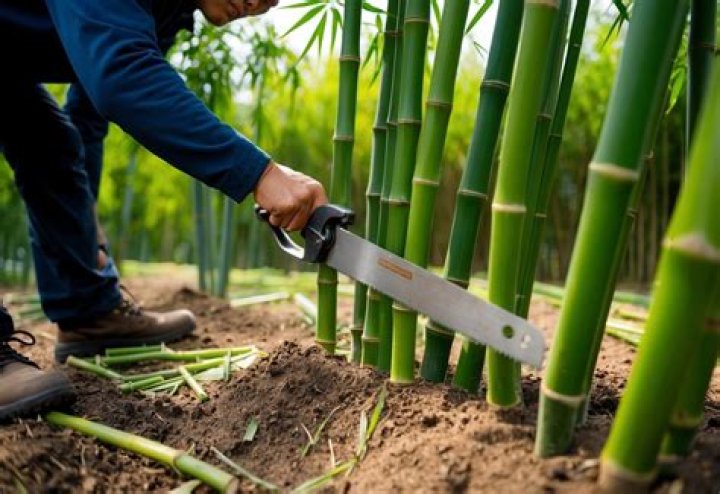
It is a very simple task to cut bamboo. The plant is hardy and difficult to kill as long as it has water. It does, however, have a tendency to splinter. When you are pruning, a splinter is not going to ruin your work, but if you are building something with it, split bamboo can seem like a disaster. Once your bamboo is cut to size, you can use it for all kinds of projects.
Step 1: Prepare the Wood
Depending on your project, you will need either green or dry stalks. Green wood is generally easier to work with. Heat the bamboo plants if the weather is cold, as this helps prevent splitting. Another useful tool to is masking tape. Place this where you wish to cut. The tape isn’t necessary in preliminary cuts or when trimming a plant, but it can still be helpful in preventing splinters. A sharp piece of wood in your finger tends to stop production, especially if you’re bleeding.
Step 2: First Cuts
The size of the bamboo determines how you should originally cut it. If it’s less than 1 inch in diameter, use a sharp pruner. If it’s more than 1 inch in diameter, use a sharp hand saw. The teeth must be straight so that you don’t tear the plant fibers. When you trim a bamboo plant, cut directly above the node. This helps eliminate unsightly stumps. Anything else you choose to do is up to you. Bamboo is hardy and can be cut into many different shapes.
Step 3: Final Cuts
Different projects require different cutting styles. These final steps are where the masking tape is most useful. If the fibers were to splinter now, you would have to begin again.
If your project is a small one, like creating beads, roll a sharp knife through the stalk. Be sure you are very slow and methodical. Don’t saw your way through. Once you have cut through you can remove the tape and continue with the project.
For a larger project you need to use a sharp handsaw and a table. Place the bamboo on the table with the part you want cut barely hanging over the edge. Hold the end of the stalk firmly on the table and saw the end off. Again, once your bamboo cutting is complete, you can remove the tape. Once all your pieces are cut, you may want to pre-drill holes for your final project. Cover the area with masking tape and slowly drill your way through. The slower you work the better.
Now that your bamboo is cut and the necessary holes are drilled, you can begin to put your project together. Good luck.
Cutting bamboo is not the same as cutting wood. This tall grass contains silica, which makes it splinter easily. Nor will bamboo culms grown back once they have been cut. You must use the right tool and make sure your cut is in the right place to keep bamboo looking attractive in the garden or to prevent spreading.
- Intro
- Running vs. Clumping Bamboo
- Tools for Cutting Bamboo
- Cutting Bamboo Poles
- Pruning Culms
- Cutting Rhizomes
- Cutting Branches and Leaves
Running vs. Clumping Bamboo
Before taking a sharp object to your bamboo, it’s important to consider what kind of bamboo you have. Running bamboos spread via underground rhizomes. A clump of bamboos all arise from a single rhizome mass and can spread very quickly. Clumping bamboo spreads differently and more slowly. These differences affect how and when you cut the culms.
Tools for Cutting Bamboo
The most important aspect of any bamboo cutting tool is that it must be able to take a sharp edge. Heavy steel is often the best choice, as bamboo culms and rhizomes are tough, and the steel will hold an edge well. Sharp pruning shears can be used on slender stalks, but a chainsaw may be best for larger culms. A fine-bladed hacksaw is a good choice for cutting poles.
Cutting Bamboo Poles
Bamboo is useful for poles in the garden or for projects like trellises. To cut bamboo poles:
- Score the bamboo along a penciled line with a sharp knife.
- Clamp in a vise or otherwise stabilize the pole.
- Saw gently along the scored line with a sharp, fine-bladed hacksaw; use a miter box for angled cuts.
- Sand gently with fine sandpaper to smooth rough spots.
Pruning Culms
A bamboo culm, or stalk, grows in length by filling its cells with water. Culms don’t grow in diameter. Once cut, a culm will not regrow. Plan your cuts ahead of time and always cut as close to the ground as possible to avoid leaving unattractive stubs. The cut should be horizontal, unlike the slanted cuts often recommended for trees.
Cutting Rhizomes
Running bamboos need regular root pruning to keep them contained. Dig a one-foot deep trench around the entire perimeter. Use a heavy, sharp, straight-bladed shovel to cut straight down through the root. A tool called a bamboo slammer, which looks like a heavier version of a lawn edging tool, is useful for cutting through a root mass when dividing plants.
Cutting Branches and Leaves
Cut branches as close to the culm as possible, using a sharp knife, pruning shears or clippers. Once cut, the branches will not grow back. However, a branch below the node you’ve cut will continue to grow. Leaf edges and tips should not be trimmed, but the entire leaf can be cut off close to the branch.
Article Categories
- DIY Prepper Projects (310)
- Emergency Kits & Gear (30)
- Free Downloads (503)
- Military Manual Downloads (100)
- Weapon Downloads (62)
- General Articles (161)
- General Building (143)
- Kitchen & Farm (428)
- Medical & Sanitation (76)
- Parenting & Family (68)
- Podcasts (41)
- Reviews (386)
- Book Reviews (224)
- Gear Reviews (162)
- Self Defense, Security, & Shooting (290)
- Survival & Outdoors (135)
- Uncategorized (1)
- Register
- Log in
- Entries RSS
- Comments RSS
- WordPress.org
Home » Articles » How to Cut Bamboo the Easy Way
I have been collecting bamboo for a new dome at the land, and hand cutting it was SLOW. Because of the effort I decided to try my weed-eater with the blade attachment with the blade pictured to the left.
This was found to be the easiest way to cut bamboo that I know.
I haven’t found a faster way to cut bamboo. Additionally, it allows me to cut the stubs of bamboo very close to the ground so that I don’t step on them and trip. A weed-eater with a saw blade is by far the best power tool to cut bamboo.
If you don’t have a weedeater, you should get one.
If you want more information on both the differences between a brush cutter and a string trimmer, as well as where to buy weed-based trimmers, I have linked to an article from toolsfreak
My Plan for the Bamboo
Once my bamboo dries out and stops shrinking I am going to cut rings of PVC and make hubs. This will allow me to lash the bamboo to the hubs to make a dome. Then I can temporarily cover and use as a form to pour aircrete. This aircrete will be made with my new aircrete foam gun so I can cast a small dome at my land.
Others have used the aircrete to cast slabs. The slabs are cut with homemade slicers made from 16 gauge steel sheet. This lets them cut out blocks that are then used to build domes. I plan to try that also. However, for now, I am trying to convince the wife that I need to cut mounds of bamboo so I can get way more than I “need” while it is available.
Then I can do lots of other projects, including making a small Da Vinci bridge with the boy. I know that using the weed-eater instead of a hand saw really helps with getting the wife’s help. Because it is the easiest method for cutting bamboo down my help stays around longer. Too many ticks, too much humidity, and too much effort makes my help go home too soon.
Related Articles
- How to Propagate Spineless Yucca
- What to Do When Bamboo Overgrows a Pot?
- Getting Dianthus to Rebloom
- Potted Rosemary Plants
- How to Prune Iberis Sempervirens
Lucky bamboo (Dracaena sanderiana) is not true bamboo but a member of the lily family hardy in U.S. Department of Agriculture plant hardiness zones 10 through 11. Lucky bamboo can grow up to 3 feet tall. If your small plant begins to overwhelm its surroundings with prolific new growth, you can cut it back to the original height, or just give it a tidying trim.
About Lucky Bamboo
Lucky bamboo is often grown as a low-maintenance plant for the home or office. It can grow in a small 4-inch container with soil or just pebbles and water. Lucky bamboo will grow in low light levels as much as 8 feet from a window. Four hours a day of bright, indirect light and a weekly water change is often enough to keep a lucky bamboo plant alive and growing, though the plant will do better with distilled water and a brighter location.
Cutting Lucky Bamboo
Cut lucky bamboo stalks do not grow. Instead, new growth will emerge from the nodes below the cuts. Nodes look like lines separating the stalk into sections. To trim down a cut stalk, cut with clean, sharp snips just above a node. Cut new growth back to above a node on the new section, or cut it where it joins the main stalk to completely remove the shoot. It is best to cut your bamboo during the winter period of slower growth.
Last Updated: April 25, 2020 References
This article was co-authored by our trained team of editors and researchers who validated it for accuracy and comprehensiveness. wikiHow’s Content Management Team carefully monitors the work from our editorial staff to ensure that each article is backed by trusted research and meets our high quality standards.
There are 14 references cited in this article, which can be found at the bottom of the page.
This article has been viewed 44,845 times.
Bamboo blinds are made with multiple pieces of bamboo tied together, and they add a simple, elegant look to your home. While you can order bamboo blinds in custom sizes, you can also cut them down yourself to save some money. If the blinds are too wide, trim some of the bamboo off of each side so they fit your window. If your blinds are too long, you can shorten them with a pair of scissors and some hot glue. When you’re finished altering your blinds, they’ll fit in your window perfectly!
u00a9 2020 wikiHow, Inc. All rights reserved. wikiHow, Inc. is the copyright holder of this image under U.S. and international copyright laws. This image is not licensed under the Creative Commons license applied to text content and some other images posted to the wikiHow website. This image may not be used by other entities without the express written consent of wikiHow, Inc.
n
u00a9 2020 wikiHow, Inc. All rights reserved. wikiHow, Inc. is the copyright holder of this image under U.S. and international copyright laws. This image is not licensed under the Creative Commons license applied to text content and some other images posted to the wikiHow website. This image may not be used by other entities without the express written consent of wikiHow, Inc.
n
u00a9 2020 wikiHow, Inc. All rights reserved. wikiHow, Inc. is the copyright holder of this image under U.S. and international copyright laws. This image is not licensed under the Creative Commons license applied to text content and some other images posted to the wikiHow website. This image may not be used by other entities without the express written consent of wikiHow, Inc.
n
u00a9 2020 wikiHow, Inc. All rights reserved. wikiHow, Inc. is the copyright holder of this image under U.S. and international copyright laws. This image is not licensed under the Creative Commons license applied to text content and some other images posted to the wikiHow website. This image may not be used by other entities without the express written consent of wikiHow, Inc.
n
u00a9 2020 wikiHow, Inc. All rights reserved. wikiHow, Inc. is the copyright holder of this image under U.S. and international copyright laws. This image is not licensed under the Creative Commons license applied to text content and some other images posted to the wikiHow website. This image may not be used by other entities without the express written consent of wikiHow, Inc.
n
u00a9 2020 wikiHow, Inc. All rights reserved. wikiHow, Inc. is the copyright holder of this image under U.S. and international copyright laws. This image is not licensed under the Creative Commons license applied to text content and some other images posted to the wikiHow website. This image may not be used by other entities without the express written consent of wikiHow, Inc.
n
Tip: Put the cord underneath the tape when you secure the roll together so it doesn’t get in the way of your cuts.
My dad has a bamboo thicket that’s overtaking his yard and he is begging me to come take some. The only problem is, I’m unsure how to properly dry it out without it cracking/checking. Any help would be awesome.
Discussions
Best Answer 10 years ago
You do it the same way as would be done with any cut lumber that is air dried.
In a place where it cannot get wet or rained on, spread it out on stickers so that air can circulate around it with as few restrictions as possible. Depending upon the climate in your area, it could take months to completely dry.
i am sewing some window blinds for a friend on a very tight budget. I’d like to know if I can use slim bamboo canes straight from the garden as a weight. It will be sewn into a cotton fabric channel at the bottom of the blind. Or should I be only using dried bamboo?
Reply 6 months ago
I know for experience after leaving cut bamboo in my yard – it can mildew. Air curing bamboo can take months. There are instructions on the Internet for heat curing, which I hear is much faster.
When I cut bamboo, I leave the branches and leaves on. I then stand the bamboo up. When the leaves are dry, the poles will be dry enough to use. (I am using bamboo poles to build a roof for my chicken pen.) People who have bamboo on their property are generally happy to have someone cut some and take it away.
We are expecting our first great grandchild in July. My husband and a friend want to try to make a crib for the baby using bamboo. They cut some yesterday and now want to know the best way to cure it and then build the crib. I read fire drying using a torch was about the best method. Any advise or help on this would be much appreciated.
thanks for the info will try them all.Will leave results neal.
my wife picked up some cut bamboo road side,its splitting its laminating and it got an itchy dust all over . help neal
I have made several bamboo flutes and found the best way to cure the bamboo is by a process called burning. Simply a propane torch. Burn all of the green surface and then polish the cane. Bamboo as a natural resin or varnish when polished, it leaves a beautiful finish.
there are several ways to dry it one you can sand the pole and use a clear sealer , two soak it in salt water for 90 day then sun dry , 3 cut it in shorter links and bake it in the oven at 225 for 4 hrs. . the only problem with bamboo is that some of the shoots will crack and split . you can also seal it with liquid glass or Thompson water seal .
there are a couple of sealer that will dry it during the drying process
I could be wrong but I don’t thing there is any problem with drying bamboo. Since it’s hollow inside there aren’t the usual stress problems associated with drying wood. When I was younger there was a cane grove near the fishin pond and we just cut a new pole at the start of summer and it lasted till it got too cold to fish. Didn’t do any drying just started using it green and it dried as it could.
Answer 10 years ago
Out of interest, how’s the big stuff turned into flat boards for flooring ? Do you know ?
Answer 10 years ago
At a guess, they steam and unroll it, then bond it like making a tabletop using narrower planks.
Answer 10 years ago
Beats me, but Sean’s answer sounds doable.
Answer 10 years ago
I also just realized that they may simply veneer it
Answer 9 years ago
after seeing some videos of workers manipulating bamboo, i think they also chop it into sections and with a small machete, they slice it into thin strips. Its almost like peeling cheese, except its made of bamboo.
Related Articles
- Is Bamboo Good or Bad to Plant?
- How to Cut Off Tomato Plant Tops
- How to Trim Lucky Bamboo Leaves to Encourage Growth
- How to Cut Back a Corn Stalk Plant
- Growing Bamboo in My Backyard
Although bamboo can be a lovely addition to a backyard garden, water feature or driveway, it is a terribly invasive plant. This means that yearly maintenance is required to control it, which involves cutting off canes. Whether you are maintaining an ornamental stand in its natural state or designing something a bit more complicated, you’ll need to know how to cut bamboo.
Bamboo Growth Habits
There are over 1,200 types of bamboo, suited to a wide range of temperature and climatic conditions, but they can be divided into two basic groups: running bamboo and clumping bamboo. The latter grows off a single base, and while it grows wider every year, it generally will stay localized in one place. Running bamboo, however, grows off of below-ground rhizomes and can therefore spread to other places in the yard quite easily if not contained.
Cutting the Top Off
Removing the top of bamboo will not result in cane regrowth, but rather in new leaves growing from the cut. These leaves provide energy to the plant’s underground system, allowing it to sprout new canes. Therefore, cutting a stand of bamboo down to the ground won’t eradicate it — stalks eventually regrow, but from the base rather than from cut canes. To prune, choose the oldest third of your canes and remove them at ground level once a year.
Where to Cut
Although there is no need to worry about damaging your bamboo no matter how you cut it, aesthetics require you to take into account where on the cane you make your cut. Choose a joint on the stalk and cut just above it, as everything left above a notch will wither and die back to that notch. If you are simply cutting canes down to the ground to get rid of bamboo or for yearly pruning, this isn’t an issue.
Designing With Cuts
Because bamboo reliably grows new leaves from the top of cut canes, you can design with bamboo by strategically placing your cuts. If you’d like to turn a clump of canes into a “tree,” tie them together with garden twine and then cut all the tops off in the same place, allowing leaves to make the top bushy. You could instead cut a row of canes in a zigzag pattern, where leaf regrowth would decorate the top in an interesting pattern.
Related Articles
- How to Plant Bambusa Vulgaris Vittata
- How to Care for a Divided Bamboo
- How to Root a Banks Rose
- How to Grow Hanging Purple Wisteria
- How to Propagate Citronella
Fast growing, tough and elegant, bamboo covers walls, provides privacy screens and adds a vertical element to the landscape. And when the wind blows, the canes brush together, making gentle music. If you already have a bamboo plant in a pot or in the landscape, it’s simple to propagate by cutting sections of the stem and replanting them, a method called culm-segment cutting. The sections of bamboo develop new roots, creating a clone of the parent plant.
Cut a bamboo cane into sections containing two to three nodes, the places along a bamboo cane where the leaves grow from. Look for the bamboo to flair out and have a slight division in it to find a node. You’ll want to do this with a bamboo cane that’s at least 1 to 2 years old and 1-inch in diameter so that it’s hearty enough to propagate a new plant.
Cut as many culm sections for replanting as bamboo plants you want to grow. Each section will grow into a new plant. Add a couple extra to make up for potential loss, rot or failure to set root.
Cut the foliage off the culm cutting with a pair of clippers.
Dig a hole in the ground or fill a 6-inch nursery pot with potting soil.
Plant the culm section in the soil with one or two node covered. Position the culm cutting so that it is vertical or at a 45-degree angle in the pot or planting bed.
Keep the soil damp by watering when the top of the dirt feels dry to the touch. New growth should appear within one month.
Things You Will Need
6-inch pot (optional)
Potting soil (optional)
The best time to transplant bamboo cuttings is in the fall at the beginning of the rainy season. Take advantage of the wet months to get your bamboo cuttings started. If you plant in spring or summer, keep the culm sections well watered. Don’t let them dry out or the roots are likely to die or simply fail to form.
True bamboo is part of the grass family Poaceae. There is another plant frequently grown as a house plant called lucky bamboo. It’s not bamboo at all. Don’t get this confused with regular bamboo or your cutting and planting efforts will not work.
When making cuts, do so at a 45-degree angle. Also, you can apply rooting hormone to the base of your cutting for quicker growth and beeswax along the top to protect the freshly cut top of your cutting.
Warning
Look for clumping bamboo types. Running bamboo spreads quickly and is hard to contain. Clumping bamboo does spread but more gradually than running types, and it’s more naturally contained.
Always sanitize your shears with a solution of 1 part bleach to 9 parts water before cutting bamboo to prevent spreading disease or pests to exposed, freshly cut stalks.
Custom cut bamboo blinds. This step-by-step tutorial will show you how to cut bamboo blinds to size using off the rack inexpensive blinds.
A few years ago, I snagged a few sets of bamboo blinds at Lowes on a super clearance. Actually, I pretty much snagged an SUV full of them. I can’t remember the exact pricing, but I want to say that the blinds were on clearance for something crazy, like $6 a piece, so I bought a lot of different options.
Here’s a super old look at our living room with just curtains. I wanted to layer the bamboo blinds underneath the curtains.
I had hoped that the blinds that I bought would be able to be hung next to each other to create one, seamless look; but, I realized that the blinds were just too long to work. I knew that I had some wiggle room with the sizing of the shades, because I was draping curtains over the bamboo shades, but the one’s that I bought needed to be altered. So, my next question was…
Can you Cut Bamboo Blinds?
The answer is yes! I searched online for a solution and came across a tutorial for trimming shades with a miter box and hack saw. I had a miter saw, so with a few tweaks to make it easier, I found my own way of making custom cut bamboo shades.
Supplies Needed
- Measuring Tape
- Miter Saw
- Painter’s Tape
- Drill
How to Custom Cut Bamboo Blinds
- Determine your window size and how much overhang you are ok with.
- Measure how much you need to take off. I needed to take off about 3″ on each side. For my window, I was using three sets of blinds, hanging then side by side as close as I could get them. I chose to leave the middle blind as-is and take off the ends on each of the outer blinds (on the side that was going to be covered by the curtain).
- Using painter’s tape, tape off your blinds where you plan to cut. To help stabilize the blind for cutting, add another set of painter’s tape about 3″ in. **While taping, make sure to grab your pull string and keep it out of the way. You don’t want to cut off the mechanism to raise and lower the blinds.
- Using a miter saw, make a straight cut down.
- Repeat as needed for other blinds.
We need to take quite a bit off to make our blinds work, and because of this, we ended up cutting off the area that secures the blind to the bracket. To fix this, we drilled a new hole next to the blind mechanism that the bracket would screw in to once it was mounted on the wall.
I did this project years ago (around 2014), so this picture is old, but on it you can see the difference in the blind on the left (which has been cut) and the middle one which hasn’t been cut.
We’ve now had these custom cut bamboo shades for over five years and they are still going strong. Check out my Forest Green Living Room for the newest details and sources.
This was such an easy project and definitely one that I’d do again.
I’ve had my spiral (sometimes called curly) Lucky Bamboo stalks for almost 8 years now. The foliage growth was getting tall and spindly so I decided to cut it all back. This is all about trimming Lucky Bamboo including how I did it and how long it took for those stems to grow back.
Now, I’ve never pruned any of mine back before so this was an experiment. Lucky Bamboos are actually dracaenas, not bamboos. I’ve successfully cut my Dracaena marginatas and Dracaena reflexa Song Of India back before so I figured this would go well. I just didn’t know how long they’d take to grow back and how many new stems would appear on each stalk (or cane).
Lucky Bamboo care is easy to care for. That’s one of the reasons these plants are so popular! They are novelty plants sold in many sizes and forms which also adds to their appeal.
Although this dracaena grows in soil in their native environments (in wet rainforests under the canopies of other plants) they’ve adapted well to growing in water.
Good Things to Know About Lucky Bamboo
Lucky Bamboo gets taller as the stems (or shoots) grow, not by the stalk (or cane) growing. If you prune the cane by half, then the height of your plant will be reduced by at least half.
Lucky Bamboo, or Dracaena sanderiana, naturally grows straight. It’s trained by the growers (mostly in China) into all the interesting shapes and forms. You can see and buy some here.
They’re sensitive to salts and chemicals in some tap water. The leaf tips will brown & the leaves will eventually turn yellow. I use distilled water to prevent this.
I keep the water level about an inch or 2 above the top of the roots. You don’t want them to dry out.
Keep your Lucky Bamboo vase or dish out of direct sunlight. Not only can that cause the leaves to burn but algae can build up in the water. Small amounts are not a worry but increased growth can prevent problems.
I change the water every month or so to keep it fresh.
Trimming (Pruning or Cutting Back) Lucky Bamboo
I’m going to explain this process with photos so you can better get an idea what I did, I long it took to start showing growth and how it looks today. When I say trimming, I mean the stem or shoot growth, not the canes.
My spiral Lucky Bamboo at the beginning of October 2018
What prompted this whole thing was the fact it got leggy. Also, some of the leaves had tipped and were turning yellowish. It wasn’t getting too much sun or fertilizer (I only fertilized once all year with Super Green) and I was using distilled water.
I’m not sure if this is due to the age of the plants & the roots getting crowded or the heat. I live in Tucson and perhaps the hot temperature and dryness of the desert had something to do with it.
Anyway, I’m always up for a new horticultural experience so time for some trimming!
How the stalks, or canes, looked after pruning the stems off in October 2018
Where to trim Lucky Bamboo: I cut the stems off as close to the canes as I could. My trusty Felco pruners were cleaned and sharpened to make precise cuts and also to lessen the chance of infection.
The shortest stem I cut off
I stuck it in water & 2 weeks later roots were showing. So yes, you can root the stems. This 1 was cut fresh with the stalk by the way.
Fast forward to March of 2019. The nodes had swelled 1-2 months earlier but at this time the growth was noticeable.
How my Lucky Bamboo looks at the end of July 2019. And yes, 1 of the canes is yellowing. More on that in a future post & video.
How to Care for Lucky Bamboo as It’s Sprouting
I kept the vase of Lucky Bamboo canes in my office near a window. It’s a north exposure but the window is large and Tucson gets a lot of sun year-round. I changed out the water (distilled) once a month. That’s it; not much care at all.
I don’t proclaim to be an expert on gardening. It’s way too broad a spectrum to claim that. I’m just someone who grew up around plants and have been working with them my whole life. This is an experience I wanted to share and perhaps yours has been way different but isn’t that what gardening (indoors or out) is all about?
The 2 things that were most interesting to me: the fact that it took longer than expected and only 1 stem appeared per cane whereas originally there were 2 or 3 stems per cane.
I did cut 1 or 2 of the canes back a bit but I honestly can’t remember which ones. Not very much, maybe 1 or 2″. I’ve read varying reports on whether the canes should be pruned or not but I imagine they can because other dracaenas can easily be cut back.
Dracaenas handle pruning very well and often times need it to control their leggy growth. Just know that if I had cut the spiral part off, it wouldn’t have grown back unless you trained it. And that is a long and somewhat arduous task. Unless you’re really into this kind of thing, it’s best to buy the Lucky Bamboo in the form or shape you want it.
I’m considering planting these canes in some soil in early fall or next spring. Another experiment to be had – I’ll be sure to keep you in the loop as to how it goes.
Need More Help with Lucky Bamboo Care? Check Out These Posts!
You can find more houseplant info in my simple and easy to digest houseplant care guide: Keep Your Houseplants Alive.
This post may contain affiliate links. You can read our policies here. Your cost for the products will be no higher but Joy Us garden receives a small commission. Thank you for helping us spread the word & make the world a more beautiful place!
It’s not uncommon to inherit or buy a piece of land on which the previous owners planted bamboo. Or perhaps you planted it and discovered that bamboo has a tendency to take over. Now you want to get rid of it, which is not that easy a task, especially if it’s running bamboo.
- Intro
- Some Background on Bamboo
- Identify the Growth Pattern
- Use the Right Techniques
- Try a Haircut
- Next – Smother
- Or Burn
Some Background on Bamboo
Bamboo is the fastest-growing plant in the world. The running varieties can be outright invasive, and many people find that out the hard way. Those qualities mean that if you want to get rid of it, you have to be prepared for some work. Nor can you relax your vigilance afterward, as it may come up again if you missed a rhizome or two.
Identify the Growth Pattern
Bamboo grows by running or clumping. Running bamboo sends out multiple horizontal rhizomes and stems, called culms, sprout along the length of each rhizome. Clumping bamboo is more like an iris or day-lily – it sends up single vertical culms. Running bamboo will regrow from any small piece of rhizome you miss in your eradication efforts.
Use the Right Techniques
Different techniques will be more or less successful. Choose among:
- Digging – more successful with clumping bamboo unless you literally sift the soil.
- Starving – may be successful if you cut religiously.
- Burning – the application of ammonium nitrate or actual fire can be a first step.
- Herbicides – while not an organic choice, it may be a last-ditch effort.
- Combination – using multiple strategies is most successful.
Try a Haircut
One bamboo plant eventually develops into a large clump with a single root mass. It’s the mature root mass that allows it to grow so fast. Begin your eradication program by cutting all the culms to the ground. Culms are tough – you’ll probably need a chainsaw for anything with a diameter over two inches. They will not regrow and the roots are deprived of their food source.
Next – Smother
Once the culms are cut off, put a large, heavy tarp over the bed. Weight it down with boards along each edge to completely shut out the light. This, plus withholding fertilizer and water, will further starve the roots. This tactic may be less successful with running bamboo, which may sneak out under the edges of the tarp. After a month, dig up the root mass and burn.
Or Burn
Summer is the best time for this one. After cutting back the culms, sprinkle generously with ammonium nitrate. Place heavy clear plastic over the clump and leave it for several days. The combination of the chemical and heat literally burns out the plant. After about a week, dig up the root mass and burn it in an incinerator.
Written by: Paul Seaburn
Written on: July 14, 2020
Bamboo may look and feel like wood, but it is actually a member of the grass family. Fresh bamboo is the favourite food of those cute Chinese panda bears, but when dried and seasoned, cut bamboo poles are great for making fences, garden canes, furniture, decorative borders and torch holders.
Because bamboo splinters easily, it must be cut with care.
Measure the piece of bamboo and make a pencil line where you want to cut it.
If making a flat cut, score the bamboo along the pencil line with the sharp knife. Use light pressure so you don’t splinter the bamboo, and make sure it is scored all the way around.
Place the bamboo on a bench, table or other raised flat surface. If you can, clamp it to the bench or place it in a vice. Saw slowly with the hacksaw at the score mark. If the bamboo begins to splinter, stop and use the knife to make a deeper score. Then saw slowly again with the hacksaw. Hold the end that is not clamped down or have an assistant hold it so that it doesn’t crack or splinter before you’re finished sawing completely through the bamboo pole.
- Bamboo may look and feel like wood, but it is actually a member of the grass family.
- Use light pressure so you don’t splinter the bamboo, and make sure it is scored all the way around.
Use a mitre box for any angled cuts. Scoring is more difficult on an angle, but it must be done to prevent splintering. Use a fine-tooth mitre saw if one is available.
Use fine sandpaper to smooth any rough spots on the cut edge. Again, be gentle to avoid splintering.
This entry was posted on November 2, 2009 by admin .
After purchasing bamboo slats, you might be wondering how to cut or how to install them. There’s no need to worry, as we have laid out some easy to follow directions for you here! Follow these directions for a smooth installation for your bamboo slats:
What You Need
- Tape Measure
- Chalk
- Table Saw (with a blade that has at least 120 teeth)
- Gloves
- Goggles
Cutting Bamboo Slats
Before cutting anything, make sure you measure the area where you plan to install the bamboo slats. Use the tape measure to acquire the measurement, hold the tape in place and find the same measurement on the bamboo slat. Using the chalk, mark the bamboo slat at the measurement you got for the area where you are installing.
Ensure your table saw is set up in a space large enough to allow for the 6-foot slats to hang off the side of your saw. Once you’ve put on your gloves and goggles, and safely plugged in and turned on your table saw, hold both sides of the bamboo slats firmly and push the slat carefully into the blade at the mark you created with the chalk.
Pay special attention to not put your fingers in the path of the blade and move the slats slowly through the blade to keep your cut as straight as possible and avoid mistakes. Additionally, please make sure your gloves and goggles are worn properly to avoid injury from any projectile debris that may be thrown from the saw.
Installing Bamboo Slats
There are multiple ways to install bamboo slats, so consider the type of surface you plan to stall on. Different installation methods work better on certain surfaces, so be sure to research what will work best for your surface before choosing the adhesive medium to use. To install bamboo slats, you will need either staples, nails, or glue, depending on the type of surface you are installing on.
Regardless of what medium you choose, be sure to space the adhering material evenly throughout the slats to ensure that the slats do not become loose in certain sections on the adhering surface. The best way to do this is to decide on an exact measurement of the space between points of adhesive contact. When using glue specifically, be sure to apply evenly throughout the entire bamboo slat to prevent bubbling or loose points that will shorten the lifespan of the slats.
Finally, when actually adhering the bamboo slats to the surface, please move slowly and carefully so that your finished product will have the best aesthetic. Applying the adhering medium rapidly can leave more opportunity for mistakes, and in the case of glue especially, can cause the amount of time your bamboo slats will stay on the surface to drastically decrease. If you have any questions about bamboo installation, please contact our customer care team!
Nice to know you can cut these to fit, if need be. Glad your “owie” is feeling better. ; )
Oh good, I was hoping you would tell us how you did that. Now that I see it I can see it was easy. Isn’t it funny how those things can be intimidating before you try it? I’m on pins and needles waiting to see the finished birthday kitchen. Lisa
Love these! They look stunning in your window! How brave of you to saw themselves yourself!
They turned out great. thanks for the nice clean pictures showing us the step by step!
Oh I do know how hard these are to cut. I did about 10 of them for my last house for the familyroom and breakfast area. A ton of work, but I love the look. Great job. Hugs, Marty
your blinds look great! way to take one for the team. i’m impressed by your efforts.
Great job. Sorry ’bout the owie. Now, tell me, can you help me if the blinds are about 3″ too short? Because that’s what I’m dealing with. 🙁
ficou linda sua janela! Você é corajosa hem, para cortar o bamboo. E o dedinho, como está!?
Man, does that look like work!! But you must have felt a great sense of accomplishment. I wonder why lowes wouldn’t cut them? Guess you have to get near to a stitching area in the cut.
I know exactly what you mean about one project leading to another and so on and so forth. Living in an old home is like living in Pandora’s Box! That was a lot of work but the results were so worth it! Thank you for sharing your secret remedy with us.
Your Friend,
Deborah
Awesome work. I’d be too afraid of ruining the blinds, but you made it look easy (except for the owie)
Hi Leslie, I once had Hubby cut down eight of these blinds. All I can say is that he was not real happy with me. After this he bought an electric saw.
Hugs, Sherry
As soon as I stop giggling, I will tell you how impressed I am!
I was just about finished with the giggles when you included your little version of Proverbs 31 at the end.
They really are great, and I’m so glad you found a solution to the window fit. I will remember it!
BTW, sorry to be so late in answering your question about the anniversary. I traveled with the husband this year and enjoyed a nice dinner with him. Thanks for the anniversary wishes!
I can never find the size of any kind of bling I need at HD or Lowe’s! Those bamboo blinds look great!
Thanks for the link to the how to freeze basil article. I’m going to try it because I’m just not ready to make pesto yet but the basil needs harvesting!
You are such a Proverbs 31 woman! I’m so impressed with your mad sawing skills – the blinds look great.
I love this! The blinds are amazing, just the right touch. Sorry about the owie, DIY’ing is murder on the manicure, hands and digits, but the finished product is much better than that manicure!
Thanks for the wonderful email. you make me smile. Still doing French in my bedroom, but having to clear stuff out and go through things.
Worked like a champ! Thanks!
That is awesome. I have been trying to find bamboo shades for my living room. I have them in the kitchen, but Lowe’s doesn’t make the right size for my living room. Mine are not matchstick though. They are a more bamboo roman shade. Visit me at
Great job ! Thanks for the wonderful cutting tip. Its really helpful !
Amazing!! You are a GENIUS.
I hope you realize that you just saved my patootie! I *just* bought these thinking it was the right size for my window (duh on me for not measuring first!) and come to find out, my window’s one of those “off sizes” that no one makes blinds for!
A random search for “Ambria bamboo blinds trim” brought me here
to your awesome post! And has given me the courage to trim mine! I just hope mine look half as great as yours do! You did a great job!
You’ve chosen the perfect bamboo for your flooring, but now it’s time to start cutting. How do you choose the perfect saw for your bamboo flooring? You’ll want to keep your costs in check while getting a clean, straight cut every time. While certain types of bamboo flooring work perfectly with a standard wood saw blade designed for hardwoods, others require something better. A clean, straight cut makes your flooring look professional and flawless. Use this guide to choose the best saw blade for your project.
Classic Horizontal or Vertical Bamboo – Use Traditional Wood Blades
For the traditional, classic look of bamboo flooring, there’s nothing better than horizontal bamboo. This popular, eco-friendly option has visible bamboo nodes and works well in almost any space except for basements and bathrooms. The horizontal grain looks stunning in modern spaces. In contrast, the striking pattern of classic vertical bamboo makes it a great choice for many interiors. Architects love the sleek, modern grain, and versatility of this type of bamboo. Given that horizontal and vertical bamboo are much softer than strand woven bamboo, standard saw blades used for common hardwoods will work great.
- How does horizontal or vertical bamboo density compare to other hardwoods?
- Both horizontal and vertical bamboo has a similar density to traditional hardwoods like oak. With a Janka Hardness rating of up to 2352, horizontal or vertical bamboo works well as an attractive, sustainable option that stands the test of time, just like traditional hardwood flooring.
- How do manufacturers construct horizontal and vertical bamboo flooring?
- Long, rectangular strips of bamboo are carefully bonded together for in a distinctive pattern. The main difference between horizontal and vertical bamboo lies in the grain. Horizontal bamboo features a wider grain with clear bamboo nodes. Construction methods for vertical create a striking yet natural look comprised of thinner lines. We age most of our raw materials for 5-7 years to improve strength and durability.
- What kind of saw blade should I use for horizontal or vertical bamboo?
- Because horizontal and vertical bamboo floorings have a similar density as traditional hardwoods, a standard wood blade works well. Carbide saw blade creates a clean, perfect cut. Look for a 40-tooth or greater standard wood saw blade. We recommend Diablo products for a picture-perfect finish.
Strand Woven Bamboo – Requires a Stronger Saw Blade
Cutting horizontal or vertical bamboo flooring is quite similar to cutting other hardwoods, but strand bamboo is very different. There’s nothing better than strand bamboo for high-traffic areas or families with children and pets. The dense, ultra-durable bamboo delivers the beautiful look of hardwood flooring while standing up to the stresses of high heels, pet traffic, and other heavy wear and tear.
- How does strand bamboo density compare to other hardwoods?
- Strand bamboo is the densest hardwood on the market. It’s almost three times the strength of an oak floor, with a Janka Hardness rating average above 4,000! This tough mother can really take a beating, and its beautiful look has universal appeal.
- How is strand bamboo constructed?
- The construction process for strand bamboo flooring is markedly different from other bamboo floors. Long, thick culms of bamboo are broken down into individual strands. and are then woven together for maximum strength, then compressed under extreme heat and pressure. The process creates a beautiful hardwood look. In addition, this construction method creates an extremely stable floor that withstands heavy wear and tear. The tough flooring of strand bamboo is the perfect choice for pet owners, families with small children, and others who want the look of hardwood without the difficult maintenance.
- What type of saw should I use for strand bamboo?
- As you might expect based on its high density and unique construction, strand bamboo requires a better saw blade than another flooring. Achieve a perfect cut on this extremely strong floor with an 80-tooth, carbide blade. We consistently get incredible results with Diablo brand blades. A standard hardwood saw doesn’t create the clean, straight cut necessary for a beautiful finish on strand bamboo. Upgrade to a better saw to get the job done perfectly.
Some Differences Between Saw Blades
Choosing the right saw blade makes a huge difference in the cut and look of your flooring. Learn more about choosing the saw blade that’s right for your project, so every cut looks clean and professional.
- What’s the difference between a 40-tooth saw and an 80-tooth blade?
- Circular table saws are the best choice for cutting your flooring, but manufacturers create each blade with 14-120 teeth. The proper number of teeth depends on your application. Blades with a lower tooth count typically cut faster, but the quality of the cut is rougher. For horizontal and vertical bamboo floors, you’ll get a clean cut with a 40-tooth or higher saw blade. However, this blade creates a rough cut on strand bamboo. For this application, you’ll need at least an 80-tooth saw blade for a clean cut.
- Why should I use a carbide blade?
- We recommend these blades because they are long-lasting, and they often create a cleaner/smoother cut. You’ll pay a little more upfront, but it’s easy for professionals to sharpen and even repair any warp on the blade. You’ll get better cuts throughout your project, which is extremely important for flooring work.
If you’re investing in high-quality bamboo flooring, it’s essential to get clean, straight cuts for a professional look. For horizontal and vertical bamboo flooring, a standard saw blade works fine. However, the unique construction and extreme strength and density of strand bamboo require a better saw blade. Whatever bamboo flooring you choose, we’re ready to help you get incredible results for a floor that meets your needs and lasts for many years. If you have to resist any questions, please contact us!
Last update of the article: 09/16/2020
Bring good luck and fortune with this Asian-inspired plant
- Pin
- Share
The Spruce / Leticia Almeida
You don’t have to look very hard to find lucky bamboo nowadays. These plants pop up in offices, on desks, in businesses, and in homes pretty much everywhere. An important part of feng shui, lucky bamboo plants are said to bring good luck and fortune, especially if the plants were given as gifts. It also helps that they have a well-earned reputation as nearly indestructible; these tough stalks can survive in vases of pure water or in containers of soil, and in a wide variety of light conditions. Even a poorly kept lucky bamboo plant will live for a long time before it finally succumbs.
The vast majority of lucky bamboo plants are shipped in from Taiwan or China, where professional growers braid, twist, and curl their stalks into a multitude of shapes. The more intricate lucky bamboo plants can cost hundreds of dollars and feature 20 or more individual stalks. More commonly, though, lucky bamboo plants in simple pots can be had for as little as $10 for a three-stalk bundle.
Watch Now: How to Take Care of Lucky Bamboo
Caring for Lucky Bamboo
There are certain growing conditions your lucky bamboo needs to be healthy, such as proper light, water, potting media, fertilizer, and temperature. When it comes to light, lucky bamboo prefers bright, filtered sunlight, such as what is found under a rainforest canopy. Avoid direct sunlight as it will scorch the leaves. They are more tolerant of too little light than too much. If the plant begins to stretch, however, or the green fades, provide more light.
Lucky bamboo can grow indefinitely in a simple vase filled with pebbles (for support) and at least an inch of water. However, they are very sensitive to chlorine and other chemicals commonly found in tap water. Water your lucky bamboo only with bottled or distilled water, or tap water that has been left out for 24 hours to allow the chlorine to evaporate. Healthy lucky bamboo roots are red, so don’t be alarmed in a glass vase if you can see red roots. Finally, good hygiene recommends that you change the water weekly.
In addition to water, lucky bamboo can be grown in a well-drained, rich potting soil. The soil should be kept moist, but not soaking. Water as you would any Dracaena species. Plants grown in water will only need to be fed every other month or so, using a very weak liquid fertilizer. A single drop of liquid fertilizer is plenty for most lucky bamboo arrangements. Alternatively, specialty lucky bamboo fertilizers are available.
As you may expect with bamboo, this plant prefers warmer temperatures of between 65 F and 90 F. Do not place the plants in front of air conditioning or heating vents, or by a drafty window.
Lucky bamboo leaves are mildly toxic, so they should not be kept in a place where pets or children are likely to snack on them.
Trimming and Shaping
Despite its intricate appearance, lucky bamboo is not shaped in the same way as bonsai, with plant wire and judicious trimming. Rather, they are shaped by rotating the plant stalks in front of a light source, thus causing the plant to naturally grow toward the light. In China, the stalks are often grown on their sides to cause the distinctive spiral. At home, this is a laborious process, but it can be accomplished by placing the plants under a three-sided box and paying close attention to its growth rate, rotating the plant slowly and regularly. Be patient, as it can take a while to get it right.
Trimming, however, is an important part of keeping your lucky bamboo healthy. Over time, most plants will become top-heavy, or intricate shapes will begin to lose their form. In general, it’s not a good idea to cut the main stalk of lucky bamboo. Instead, cut the offshoots with sterile snippers. You can trim offshoots back to within an inch or two of the main stem. New shoots will soon emerge, and the resulting plant will be bushier. To discourage new growth, dip the cut end in paraffin.
If you want to change its shape dramatically, you can cut a whole offshoot flush against the main stalk. A tan scar will result, and new shoots may or may not emerge from the cut. Don’t throw the trimmings away, as they can be used to propagate new lucky bamboo plants. If you need to trim the main stalk for some reason, new shoots will emerge from below the cut, and the top portion—assuming it’s healthy—can be used to start a new plant.
Common Problems
The most common mistakes related to lucky bamboo are usually connected to the water. Chlorinated water will kill them over time, and water that is dirty or infected with bacteria can be deadly. If a plant develops black roots, these should be cut away. Similarly, dead leaves should never be allowed to rot in the water as they might introduce bacteria. Practice good water hygiene by changing the water every week with distilled or bottled water. If algae are growing in the water, it’s usually because the plant is potted in a clear vase, allowing light to penetrate and encouraging algae growth. Just clean it out and start again, switching to an opaque container if algae is a persistent problem.
Leaves that are yellow usually indicate too much sun or too much fertilizer. Cut out the fertilizer and move the plant to a shadier location. Brown leaves usually indicate dry air or polluted water. Raise the humidity level by spraying the plant regularly and make sure you’re using the appropriate water.
If the stalks themselves begin to rot or turn mushy, they are likely beyond saving. Worse yet, decaying stalks threaten any other stalks they are close to. Remove them at once. If you really want to save it, cut away the yellow parts and try to root the trimmed stalk in new water.
Finally, lucky bamboo is susceptible to the same insect problems as other indoor tropical plants. They can be treated manually (picking off bugs) or by the same methods you’d use on any other indoor plant.
By: Sarah Metzker Erdemir
21 September, 2017
Do not use these steps to prune a lucky bamboo plant. Lucky bamboo is not a true bamboo, and it requires different care.
Bamboo is a lush, fast-growing plant with verdant leaves and stalks. Large bamboo plants in your home can look and feel like an indoor jungle. Tropical varieties grow well in pots indoors, and they are relatively easy to care for. With regular watering, misting and twice-yearly fertilization, most indoor bamboo plants will flourish in partially sunny locations. Pruning your bamboo plant is only necessary to remove tired-looking branches and leaves and to keep the plant from growing too large for its pot and becoming root bound.
Clip off any dead, dying or yellowed leaves and branches from your bamboo plant. A few leaves can be left on the soil or buried just beneath the surface to fertilize the plant as they break down. Don’t worry if your indoor bamboo plant suddenly drops all of its leaves. If the plant is getting enough water and the right kind of light, this usually just means the plant is entering its dormant phase before beginning a new period of growth.
- Bamboo is a lush, fast-growing plant with verdant leaves and stalks.
- Pruning your bamboo plant is only necessary to remove tired-looking branches and leaves and to keep the plant from growing too large for its pot and becoming root bound.
Snip off new shoots at the soil’s surface if you want to keep a bamboo plant from spreading too much. Rhizomes are the yam-shaped growths that produce roots and stalks. Check the bottom of the pot once or twice a year to see whether any new rhizomes are coming out of the drainage holes, and cut them off with a strong pair of shears or a sharp handsaw.
Cut off any stalks that turn yellow and dry out. Cut them just at the surface of the soil below the lowest joint, taking care not to damage the other parts of the plant. Shears should work for smaller indoor bamboo plants. You might need a handsaw to cut dead stalks from larger plants.
- Snip off new shoots at the soil’s surface if you want to keep a bamboo plant from spreading too much.
Cut off the tops of the stalks to keep bamboo from growing too tall. Make the cut between joints at the desired height using shears or a sharp handsaw. Once a stalk is cut, it will not grow any taller.
Divide bamboo plants that are getting too large for their pots. Dig out the soil at the base of the plant with a trowel and cut off smaller rhizomes from the larger parent rhizome. You can plant the rhizomes you’ve cut into new pots or throw them away.
Lucky bamboo plants (Dracaena sanderiana) are common houseplants, and are fun and easy to grow. Indoors, they can quickly reach a height of 3 feet (91 cm.) or more, prompting gardeners to ask, “Can you prune lucky bamboo?” Fortunately, the answer to that question is a resounding “yes!”—and it is a cinch to do.
Can You Prune Lucky Bamboo Plants?
Lucky bamboo isn’t really a type of bamboo at all, but rather a plant in a genus of trees and shrubs called Dracaena. Because lucky bamboo grows so fast, it has a tendency to become top-heavy, and the extra weight puts stress on the roots and the rest of the plant.
Cutting back a lucky bamboo plant invigorates and refreshes it and encourages new growth. If desired, selective lucky bamboo plant pruning can even change the shape of the plant entirely.
When to Prune a Lucky Bamboo Plant
When to prune a lucky bamboo plant depends on the height of the plant. You don’t have to wait until a certain time of year to do the job. You can prune lucky bamboo whenever it gets too large to manage.
Lucky Bamboo Plant Pruning
Using very sharp, sterile pruning shears, cut back any shoots that are thin, overly long, or growing crookedly. The shoots are the stems that have leaves on them. Trim back shoots to a length of 1 or 2 inches (2.5-5 cm.) from the stalk. This will encourage more shoots to grow from the cut area and will create a denser, bushier look.
If you wish to cut back your lucky bamboo more drastically, with the intention to reshape it, you can cut as many shoots as you want flush to the stalk. Usually, new shoots will not regrow from the pruned areas due to the close cuts.
Alternatively, you can cut the stalk to the desired height. Because of the possibility of infection, this is riskier than simply trimming shoots away. Plan carefully before you prune and be aware that the stalk will not grow any taller than where you make the cut. Only the new shoots will increase in height.
If you take a close look at the stalk of your lucky bamboo plant, you will see clearly defined rings, called nodes, on it. Make your pruning cut just above one of the nodes. Your cuts must be clean and smooth to minimize the chance of infection. There is no need to cut either the shoots or the stalk at an angle.
With a little planning and a few choice cuts, pruning lucky bamboo plants is an easy task!
Profitable Bamboo Poles
Borrowing a successful sales method from U-cut Christmas tree growers, an enterprising bamboo grower has developed a unique part-time business that brings yearly profits of over $40,000 working just one day a week. He sells U-cut bamboo by the foot on his one-acre bamboo patch.
He planted several varieties to give customers a choice of colors and sizes, ranging from pencil-thin stalks to huge 6 inch diameter timber bamboo poles. His best-selling varieties include Arrow bamboo, Black bamboo, Incense bamboo, Golden bamboo, Red Fastuosa bamboo, Tonkin Cane bamboo, Henon bamboo, Tanakae bamboo and Moso bamboo.
Because he’s a self-described “geezer,” his goal is to reduce his Saturday workload to just collecting the money and chatting with customers about bamboo. A large photo album full of pictures of bamboo projects completed by customers is his only sales aid, and a tiny classified ad in the local paper for three summer months brings all the customers he can handle. Customers cut and load their own bamboo, and the poles are priced reasonably to encourage do-it-yourselfers.
The bamboo shoots grows 20 to 50 feet in just one year, and so the bamboo patch is almost totally self-renewing, with just one application of fertilizer per year. Bamboo plants reach their maximum height and diameter in a single season, so the patch is ready to cut again each year. Customers use the poles for fencing, furniture, duck blinds, crafts, flutes, wind chimes, water pipes, concrete reinforcing, privacy screens and garden art projects.
Bamboo garden art
This could be a perfect business for anyone with a spare acre or two that is near a population center of at least 25,000 people. To keep your hours to a minimum, open to the public on Saturdays only.
Bamboo is not just a tropical plant, as many types are cold hardy to winter temperatures between -10 degrees and +15 degrees. The Panda bamboo, which originated in the Himalayas, is cold hardy to -25 degrees.There are dozens of bamboo varieties that are ideal for a u-cut bamboo operation, including the ones listed above.
Local bamboo growers have a big advantage over low-cost producers in Asia, as shipping costs can inflate prices dramatically. Selling direct to the consumer with a U-cut operation allows retail customers to still enjoy low prices by harvesting their own poles. Plus, customers almost always prefer to support local growers. Just like looking for the perfect Christmas tree, customers enjoy searching for the “perfect” bamboo poles, and it’s a great outing for the whole family.
One Oregon bamboo grower has focused on an even smaller niche for this profitable plant, specializing in producing six varieties of bamboo that are just the right size for fencing, with poles from 2 inches to 3 inches in diameter. He produces “value-added” fencing panels 6 feet high ( the maximum height allowed by most building codes) and 8 feet wide., drilling and threading the poles together with copper wire. His two acre bamboo farm is sold out every year, with about half the customers buying just poles to make their own fences and the other half buying ready-to-go fence panels.
To learn more about growing bamboo for profit, including detailed information on the 33 best varieties to grow and value-added container bamboo, read Growing Bamboo For Profit.
Eats, shoots and leaves.
Bamboo Piece, Bamboo Shoot and Young Spring Bamboo are materials used for crafting in Animal Crossing: New Horizons.
With the help of these materials, you can create your own little zen garden.
The only problem is that, unlike other materials like Iron Nuggets, bamboo materials can’t be found on your island. Instead, you need to cross the sky and sea to find and grow bamboo.
Bamboo in Animal Crossing: New Horizons explained
In New Horizons, there are three different types of bamboo related materials for you to find and use in DIY recipes:
- Bamboo Piece
- Young Spring Bamboo
- Bamboo Shoot
While Bamboo Piece and Young Spring Bamboo are just materials, like Hardwood for example, Bamboo Shoots can also be eaten and planted like the fruit that grows on your island.
How to find Bamboo Piece and Young Spring Bamboo in Animal Crossing: New Horizons explained
Unless you have a friend who is willing to share their bamboo material haul in New Horizons, the only way you can find these materials is by getting off to a mystery island.
To do this you need to buy a Nook Miles Ticket from the Nook Stop in Residential Services for 2000 Nook Miles.
Take this ticket to the Airport and they’ll bring you to a randomly selected island.
Hopefully you’ll land on an island with bamboo.
The downside is that, just like your chances of visiting Tarantula Island, there are no guarantees on whether the island you visit will have bamboo growing on it. You will simply need to keep earning those Nook Miles and spending those Nook Miles Tickets till you land on an island with bamboo.
Make sure you leave a good amount of space in your inventory too – you don’t want to run out of room for all that bamboo.
How to grow bamboo on your island in Animal Crossing: New Horizons explained
The best way to ensure you always have access to any bamboo related materials in New Horizons is to grow it on your island.
To do this you need to dig up Bamboo Shoots, which are buried around bamboo.
Take these Bamboo Shoots back to your island and, just like you would with a fruit tree, plant them in the ground.
Bamboo grows under the same conditions as trees. This means that it won’t grow if it’s adjacent to another tree, bamboo stalk or object.
If these conditions are met, then your bamboo will grow in three days, leaving you with an easy way to collect these materials. Just make sure you don’t accidentally cut it down!
I’ve already started on my own bamboo grove.
New to Animal Crossing? Our Animal Crossing New Horizons tips can help with the basics. From the off, there’s fish and bugs to catch, flowers and fruit to grow with Leif selling seeds, villagers to add or remove and tools such as the new ladder and vaulting pole to collect. Once you have settled in, you’ll want to be making as many Bells as possible, start collecting K.K. Slider songs and work on your island star rating, increase your HHA ranking, incorporate Feng Shui into your room design and acquiring kitchen furniture. You can also buy fake art from Redd, use the Dream Suite and island backup. Recently acorns and pine cones were added.
Uses for Bamboo Piece, Bamboo Shoots and Young Spring Bamboo in Animal Crossing: New Horizons explained
All three bamboo related materials – Bamboo Piece, Bamboo Shoots and Young Spring Bamboo – are used in a variety of DIY recipes, including furniture and flooring.
You can use these materials to craft a Hearth or a Bamboo-shoot Lamp among many other objects.
Try to keep a good amount of all bamboo related materials in your storage – you never know when you might need them.
Sometimes we include links to online retail stores. If you click on one and make a purchase we may receive a small commission. For more information, go here.
When lucky bamboo is too tall, it’s necessary to cut back the sprouts grow too tall and dying leaves. Knowing how to trim lucky bamboo or cutting a lucky bamboo stalk in half to propagate it from the trimmings is a valuable skill if you have these plants in your home or office.
How to Trim Lucky Bamboo Plants
Lucky bamboo (Dracaena sanderiana) is a versatile plant that can grow either in water or soil. Can you prune lucky bamboo? Not only can you cut a lucky bamboo plant, but if the plant grows too tall, it is necessary. Trim it without worry over stunting its growth since it’s a hardy plant, and pruning makes it grow faster.
Tools to Prune Lucky Bamboo
You don’t need many tools – just a pair of very sharp pruning shears or scissors.
- Be sure your scissors or pruning shears are sharp.
- You want the cuts to your plant to be clean, not jagged.
- Ragged cuts and tears present opportunities for unwanted bacteria and disease to enter into the healthy plant shaft.
Trimming Stalks Versus Sprouts
The size of the bamboo shafts in your arrangement won’t change, but the height of your arrangement grows as new sprouts emerge from the stalks.
- Don’t trim the bamboo stalks unless you wish to change the height of your arrangement.
- Once you’ve pruned a stalk, it remains the trimmed height since the bamboo stopped growing as soon as it was harvested for your arrangement.
- The sprouts (leaves) are the only part of your arrangement that continues to grow after harvesting and eventually need trimming.
- If you wish to shorten the length of the stalks, cut them and then propagate the cut halves in water or soil to create another arrangement.
- New sprouts will grow from the cut stalks and soon you’ll have another arrangement.
- Be sure to keep the leaves out of water since the leaves will rot if left soaking in water.
Trimming Lucky Bamboo Plants
It’s always best to trim less than what you’ve planned to ensure you don’t over prune your arrangement. You can always trim more if necessary. Start trimming around the bottom of the plant and work your way up toward the top.
Importance of Pruning Your Bamboo Plant
Trimming encourages new growth and is necessary as your plant ages. The sprouts continue to grow while the stalk remains the same height and thickness. This can cause arrangements to eventually become top heavy and necessitates a trim.
- If it’s your intention to root the cuttings, snip the sprouts about one or two inches away from the main stem just below the node.
- The node is where the sprout first emerged from the shaft.
- This is the area where new roots will form and soon give you a new plant. That’s why it’s important that you cut the sprout so the entire node stays intact with the cutting.
- Some people insist you must cut a sprout at an angle in order for it to root. This isn’t true. You can cut the sprout either straight or at an angle and still have a good root system grow from the cut.
- Leave a one to two inch nub on the shaft; this will encourage new leaves to grow from the cut area.
- Trimming also helps your bamboo grow back fuller than it was before you trimmed it.
- If you don’t want more growth on your plant, then use paraffin to seal the wound left by cutting the sprout off of the shaft.
Trimming Just Leaves on Lucky Bamboo Plants
Leaves can die for any number of reasons, so you want to trim these from the sprout. Pruning leaves from the sprout or stem encourages more leaf growth. If you wish your plant to branch out and produce more leaves, then you can selectively trim just the leaves.
- Cut the leaf away from the sprout or stem. The stem from the sprout may be very long with multiple leaves along the shoot.
- Make the cut right along the stem at the point where the leaf grows out from it. Be careful not to cut too close to the stem. While you want to remove the yellow/dead leaf, you shouldn’t strip it from the stem. Make your cut just below the yellow or dead part of the leaf, leaving the remaining green part growing out from the stem or sprout intact. This area will recover quickly and soon you’ll have new leaves growing in place of the cut leaf.
- If the leaf is close to the sprout, then cut at least one inch above the sprout.
Change the Shape of Your Lucky Bamboo Plant
If you decide you no longer like the way your lucky bamboo arrangement looks, you can make a drastic change by cutting all the sprouts back to the stalk. In this case, you’ll want to trim the sprouts flush with the stalk. Because you’ve trimmed the sprout so close to the stalk, new sprouts might not grow from the trimmed area.
Risk of Infection
If you cut the stalk of your bamboo, there’s a risk of bacteria seeping into the cut area. If your bamboo becomes infected, the water will turn murky or brown and have an unpleasant odor. At this point there’s very little you can do to save your bamboo and it should be thrown away.
How to Propagate Lucky Bamboo From Cuttings
Select only choice cuttings to root.
- Make sure the sprouts you use have at least two leaf points to ensure you have enough of a sprout to root.
- Trim to the growth node.
- Place the sprout in either soil or water to allow roots to grow.
- When the roots start to grow, if propagating in water, add marbles or small stones to stabilize the plant.
- Care properly for the new lucky bamboo plant.
- Some people use rooting hormones to encourage fast root systems. If your plant is healthy, you won’t need to use this.
Regular Trimming Keeps Bamboo Healthy
Cutting lucky bamboo is easy when you follow these instructions and will keep your plants healthy if done on a regular basis.
Bamboo, a plant native to Southeast Asia and South America, grows surprisingly well in the southern United States. And under the right conditions, it can spread rapidly. Trying to contain one of the “running” types (as opposed to the tamer “clumping” types) is a problem for many gardeners. But persistent natural measures—as opposed to a chemical attack—can safely eradicate the plant. These methods can be used either to turn an unruly bamboo patch into an attractive part of your landscaping or to rid yourself of the invasive plant for good.
What You’ll Need
Equipment / Tools
- Gardening gloves
- Pruners
- Handsaw
- Lawnmower
- Garden hose or sprinkler
- Spade shovel
- Axe
Materials
- Tarps or plastic garbage bags
- Landscaping pins or rocks
Instructions
Cutting and Watering Bamboo
Some experts recommend continuously cutting and watering a bamboo grove to eradicate it. This removal method involves cutting the plants to ground level to prevent them from completing photosynthesis. The process might need to be repeated for up to six months to achieve full eradication.
Cut Bamboo to Ground Level
Cut the bamboo to ground level with pruners or a handsaw. Immature plants that exist on the periphery of the grove can also be mowed down with a lawnmower.
Water the Area
Water the area thoroughly with a garden hose or sprinkler.
Repeat
Repeat this cutting (or mowing) and watering process until you’ve exhausted the roots of their energy store. Eventually they’ll no longer send up new shoots.
Allow any remaining rhizomes (underground stems that send up new shoots) to rot in the soil.
Digging Up Bamboo
The process of digging up bamboo takes effort, and it can be a year or more until you achieve eradication. Thus, this method is recommended only for smaller patches or clumping varieties. Clumping bamboo does not contain rhizomes, so it’s easier to remove from the soil.
Water Bamboo
Water the bamboo patch with a garden hose or sprinkler. Allow the moisture to soak into the soil for about half an hour.
Cut Down Bamboo
Cut down the bamboo with pruners or a saw, so only a small amount of greenery extends from the earth.
Loosen the Soil
Using a spade shovel, dig around the base of the bamboo plant to loosen the soil.
Pull the Plant Out
Pull the plant from the ground, rootball and all. For nonclumping varieties, follow the plant’s rhizomes as best as you can to remove all of the underground shoots.
Break Up Rhizomes
Use an ax to break up the rhizomes. Remove all pieces of the rhizomes if possible.
Repeat
Repeat the process until you’ve dug up and removed the whole patch.
Dig Up New Shoots
Dig up new shoots once they form, and remove the rhizomes below the surface. Repeat the process until nothing grows back.
Smothering Bamboo With Tarps
Another method for ridding your yard of bamboo is smothering the plant with tarps. This typically takes around two months. However, the bamboo might be able to spread beyond the covered perimeter, so you have to closely monitor the situation.
Cut Bamboo
Using pruners or a handsaw, cut the bamboo to ground level.
Cover With Tarps or Garbage Bags
Cover the entire area with dark plastic tarps or garbage bags. Secure them with landscaping pins, or place rocks on top of the tarps.
Wait several weeks or months until the contents below the tarps have suffocated.
If the covered bamboo patch sends out rhizomes beyond the tarps, creating new sprouts, cut and cover the sprouts immediately. Alternatively, plant other proliferating perennials around the border to create a natural barrier that will crowd out new bamboo shoots.
When to Remove Bamboo From Your Yard
Bamboo spreads by rhizomes in the soil. So to eradicate it completely, you must attack not only the aboveground greenery but also the below-the-surface shoots. This requires diligent effort that must begin in the spring and continue throughout the plant’s growing cycle. In mild climates where bamboo thrives, this could mean year-round removal efforts until the grove is eliminated.
Tips for Removing Bamboo From Your Yard
When digging up bamboo it might help to have a sifter, so you can sift through the soil to locate stray rhizomes. Any fraction of a rhizome left behind can result in a new shoot.
For the smothering method, consider enlisting the help of buried barriers. You can effectively fence in the bamboo by sinking plastic barriers into the ground around the grove. Barriers should run 30 inches deep and extend a few inches above the ground to prevent rhizomes from weaseling their way over the top. This method also works well if you have a patch of bamboo you want to keep yet control.
Polygonum cuspidatum, also known as Japanese bamboo or Japanese knotweed, is not a true bamboo, but it acts similar to one. You can use the same methods to eradicate this species.